Auto-Documentation Tools That Update on Git Push
Two architectures handle documentation updates on code changes, each trading automation for control.
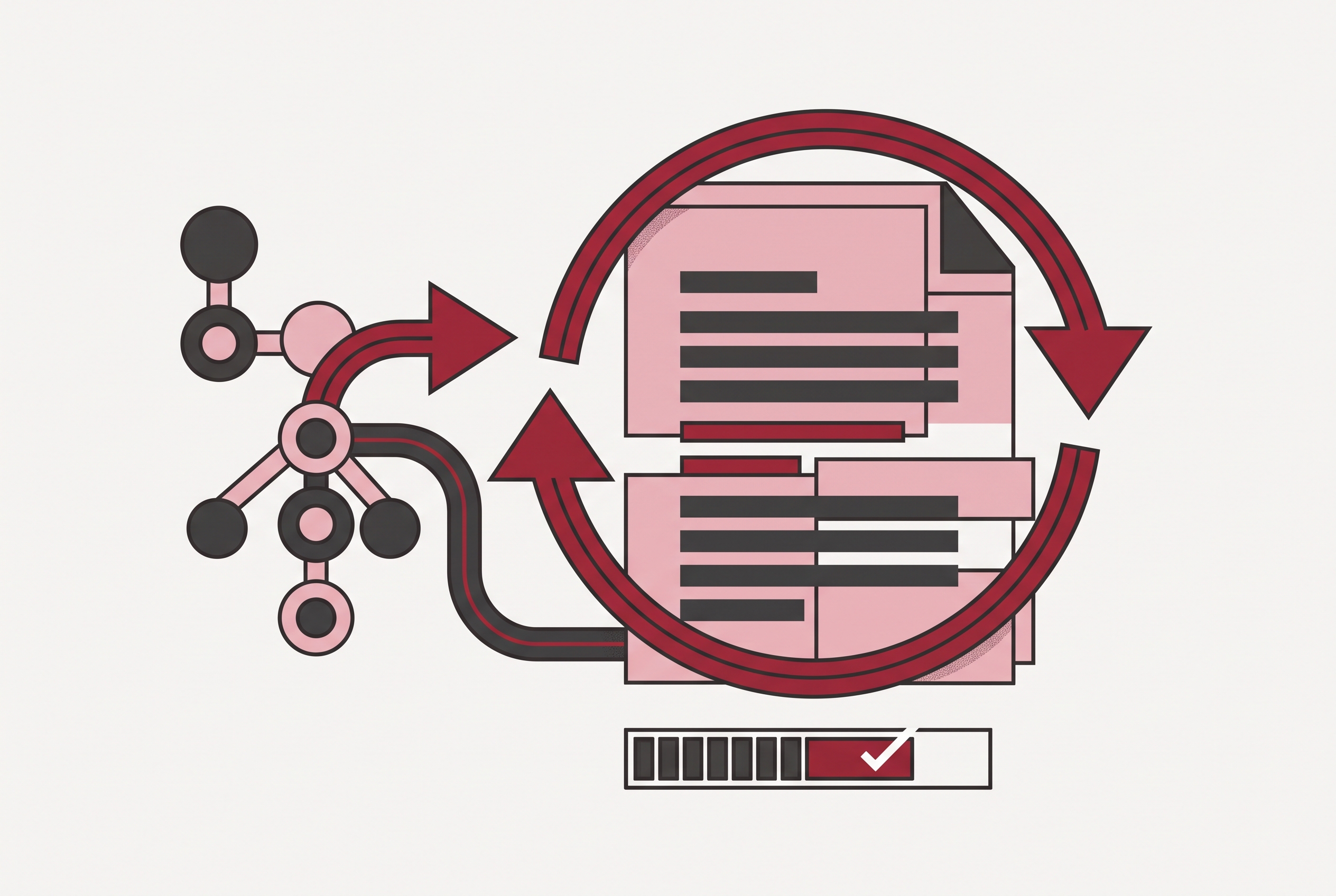
Auto-documentation tools that update on Git push follow two architectures, regeneration-on-push and drift detection with coupling. The choice is whether to rebuild documentation from source or keep it and check it against the source. That choice sets what automation can safely publish, where people need to review it, and how to keep documentation reliable as a codebase grows.
Why documentation that lives outside the codebase drifts the moment code changes
Documentation kept apart from code gets updated on its own schedule. A code change can complete its path through development without changing the document that explains it. Divergence is therefore the default. Teams may automate builds, tests, deployments, and rollbacks while leaving documentation dependent on someone remembering. The more often they ship, the faster that gap grows.
The consequences include developer interruptions, onboarding friction, and rising support ticket volume. Each reflects the same missing connection between a change and its explanation. AI coding agents, including Claude Code, Cursor, and Copilot agent mode, add another consumer of stale documentation. They get much of what they know from docs and can confidently follow out-of-date instructions, bringing errors into pull requests. Keeping documentation up to date therefore improves the developer experience and is part of the infrastructure needed for safe agentic workflows.
The two architectural models that push-triggered documentation tools use
Regeneration-on-push treats a Git event as an instruction to derive documentation again from an authoritative source. That source may be code, annotations, or a machine-readable specification, and the new output replaces the old document. Its strength is freshness without a human deciding which generated passages need updating. But when parts of the source are missing or unclear, parts of the documentation will be missing or unclear too. The model fits content substantially derivable from source, including API references, inline comments, and README files.
With drift detection with coupling, a Git event tells the tool to check the documentation it has against the code that changed. It links documentation nodes, including tokens, snippets, and sections, to source identifiers, then resolves minor differences or flags significant ones. Its strength is preservation, because authored context and business logic remain intact while review targets the affected passages. But the detection pass can only help with documentation that already has links. The model suits internal knowledge bases, conceptual guides, and runbooks that are useful because of how people explain things.
A platform can regenerate reference pages from a specification while protecting narrative guides through coupling or review. The relevant distinction is what happens to each document. Most tools still have one primary mechanism, which shapes their configuration and their limits.
How regeneration-on-push works under the hood, from Git event to published output
The pipeline begins when a push or merged pull request fires a webhook or starts a CI job. The event carries the diff, branch, and commit SHA, connecting the build to a particular source state. A documentation platform can receive that event directly, or a GitHub Actions workflow can handle it. This trigger initiates the work but does not itself determine how documentation is produced. The next stage depends on what the repository contains.
During the source read, a parser extracts the material the generator will use. API documentation can draw from an OpenAPI (OAS 3.0+), AsyncAPI, GraphQL, or SOAP specification. Code-level documentation uses AST parsers to extract function signatures, type annotations, and inline comments such as JSDoc or DocBlock. For prose-first documentation, Markdown or MDX files are already the content. In that case, automation assembles and deploys the writing.
Generation then converts the parsed source into HTML pages, Markdown files, or a documentation site. Pure spec-to-reference generation is deterministic and auditable, whereas an LLM summarization pass introduces non-determinism. Identical code can produce different prose, making this the point where hallucination risk enters the pipeline. Deployment finally commits output to a documentation branch, sends it to a hosting platform, or publishes it through a CLI. Versioned builds and pull-request previews can sit around these stages, but the underlying sequence remains trigger, source read, generation, and deployment.
How drift detection with coupling works, from Smart Tokens to selective human review
Coupling starts before the first detection pass, when documentation is linked to source code. Swimm’s Smart Tokens point to source symbols such as variables and function names. Code snippets are tracked as a feature of their own, separate from those tokens. These links give the detector a registry against which it can compare changes and identify affected documents selectively.
Swimm’s synchronization algorithm runs automatically on every pull request and checks the documentation it has against changes in the pushed code. Small changes, such as a renamed variable or reordered parameter, can be resolved without a person stepping in. Bigger changes, such as a removed function or changed API contract, need someone to look at them. A failing documentation-freshness check can then block the merge just as a failing test does.
The boundary is equally important. A coupling-based detector monitors existing links, so it cannot discover undocumented code that was never connected to a document. Its precision therefore depends on both correct links and their coverage as the repository changes. Within that coupled set, review can focus on documentation affected by the change. The trade-off is more setup work upfront in exchange for selective detection and preservation of authored content.
Where the regeneration model is deployed, including Read the Docs, Redocly, DocuWriter.ai, and DIY GitHub Actions
Read the Docs owns the build-and-host portion of the pipeline. It automatically builds and deploys documentation from GitHub, GitLab, or Bitbucket on every push, with support for Sphinx, MkDocs, and Markdoc. It also provides versioned documentation and pull-request previews, with free hosting for open-source projects. It requires the team to supply accurate source documents, making it a fit for projects that already have written documentation and need reliable push-triggered publication.
Redocly concentrates on API specification governance and the spec-to-reference layer. Redocly’s API documentation says that references update automatically when an OpenAPI description changes, and its CLI can run in a CI/CD pipeline. The team must configure that connection before a push can cause regeneration. The division of responsibility is therefore explicit, with the tool handling reference production and the team owning the CI wiring. In this setup, narrative documentation is kept apart from the output built from the specification.
DocuWriter.ai extends regeneration across a broader documentation suite. Its integrations include Git, n8n, and MCP for coding assistants, with either Git events or schedules serving as triggers. Test generation, refactoring, and language conversion place it in the wider code-assist category. DocuWriter.ai also states that it processes code in memory without retaining it or using it for model training, a relevant distinction for enterprise procurement.
With the DIY GitHub Actions pattern, the team is in charge of every stage of the pipeline. A workflow running on push to main invokes TypeDoc, Sphinx, JSDoc, or an OpenAPI generator through a CLI. It then commits output to a docs/ folder or deploys it to GitHub Pages. Teams that know CI/CD well can use this to control trigger conditions, parsers, formats, and deployment targets without having to depend on a documentation platform. The corresponding cost is ownership of pipeline failures, versioning logic, and hosting uptime.
Where the drift detection model is deployed, with Swimm for internal docs and Mintlify Workflows for public-facing developer docs
Swimm applies coupling to internal engineering knowledge, including runbooks, onboarding material, and architectural guides. These documents explain decisions and business logic that cannot be recovered simply by rendering function signatures. Smart Tokens and tracked snippets anchor that narrative to the private codebase, while the CI check gives freshness a place in the merge process. Swimm can identify affected documents and generate updated content without replacing the entire authored explanation. Its fit is strongest where preserving internal context matters as much as tracking code changes.
Mintlify Workflows addresses public-facing documentation through a different drift-response process. Documentation lives in Git as MDX, with bi-directional sync carrying repository changes into the editor. After a pull request merges, the Workflows agent reads the diff, identifies affected sections, and drafts updates. Those updates can enter a pull request for review or be pushed directly, so review before publication is configurable. This is a review-oriented response to changed code, leaving the use of the same token-coupling mechanism as Swimm unconfirmed.
Workflows can also sync on pushes, generate release changelogs, audit broken links on a schedule, and draft documentation for new endpoints. Every public Mintlify site generates llms.txt, llms-full.txt, and skill.md, serves clean Markdown through content negotiation, and has an auto-hosted MCP server. These features make current documentation available to coding tools, but the MDX-in-Git model can still constrain contributors without pull-request fluency.
The human-review question, where automation should stop and why
Automation can publish incorrect information at the same speed as correct information, giving both the authority of a canonical page. LLM-generated prose may lose intent, context, or business logic even when it describes current code. Non-determinism is inherent to that generation step, including when it is triggered by a push. The sound design response is to separate generation from publication and place review between them where interpretation is involved.
That boundary can exist in several parts of the workflow. Mintlify Workflows can draft a pull request that a person approves before publication, while Swimm places human attention at the CI gate for significant changes. DocuWriter.ai’s Git-native workflow allows generated output to be reviewed before merging into the documentation branch, even where the platform does not enforce that review. In a DIY GitHub Actions pipeline, the team must set up that branch to require pull-request approval. The presence of Git integration alone does not establish a review gate.
Evaluation of generated documentation is also becoming more formal. A 2025 arXiv preprint introduced ReleaseEval, a benchmark for evaluating language models in automated release note generation. That work reflects the governance questions that accompany documentation automation, but it does not eliminate the need to control publication. The practical heuristic is to match the gate to the generation step. Deterministic output from a valid specification can auto-publish, but someone needs to review non-deterministic narrative output.
Choosing between the two models based on doc type, team structure, and codebase growth
Choose regeneration-on-push when the document is substantially derivable from a machine-readable source. OpenAPI specifications, code annotations, and type signatures provide the clearest foundation for that choice. For an external reference whose main job is to reflect the current interface, rebuilding is a direct fit. If the content is already written, choose the build-and-host variant. If generation adds AI prose, keep the publication gate even when the goal is to do less documentation work by hand.
Choose drift detection with coupling when the document’s value is its human-authored explanation. Business logic, architectural decisions, and onboarding context need to be preserved. For internal teams that require freshness to block a merge, the coupling-and-CI model supplies the relevant control. That choice also commits the team to linking new code to new or existing documentation. Without that discipline, growing code coverage does not translate into growing documentation coverage.
Choose a hybrid when reference pages and narrative guides share a documentation estate. Regeneration can build the public API reference while coupling protects internal knowledge and people review the drift response that keeps public explanations up to date. Mintlify combines spec-driven reference regeneration with Workflows-based response for public docs, subject to automation-plan requirements and the contributor constraints of MDX in Git. Team structure matters because a workflow that depends on pull-request fluency can leave non-developer contributors at a bottleneck.
Regeneration handles volume but inherits declining source quality, while coupling preserves precision only as new links extend its coverage. Reliability comes from treating freshness as a scored, owned, CI-enforced property of the code.